
A camper parked in the open takes a beating. Summer sun cooks the roof seals and fades the decals, pine pollen and leaves pile up on the awning, and one hailstorm can dent and crack what years of sun did not. A pontoon boat or a livestock trailer has the same problem, and most of them are too tall to fit under an ordinary carport. An RV cover is the answer: a steel carport frame set on taller posts so a high load can pull straight in.
RV covers are designed for RVs, pontoon boats, livestock trailers and other heavy equipment, and they come three ways: cover only, partially enclosed, or fully enclosed. Advance Solutions LLC, an authorized steel building dealer in Holly Springs, Mississippi, helps you measure what you are storing, pick the height and layout, and price it for your ZIP code. Once your site is ready, we deliver and install it anywhere in Mississippi or Tennessee, with a certified installation crew doing the setup.
The biggest mistake with an RV cover is buying it too short. Most of this page is about getting the height and layout right the first time.
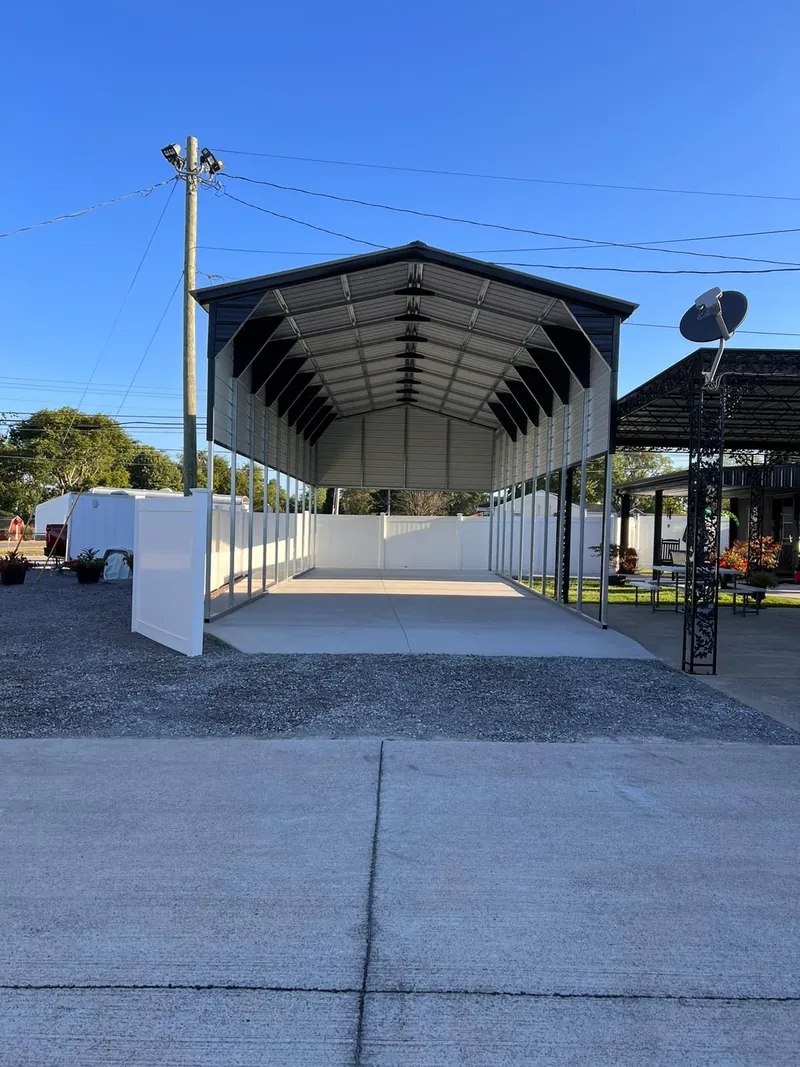
Side Heights for What You Are Storing
RV covers come 12 to 30 feet wide, start with 12-foot posts, and can go as tall as 16 feet on the sides. The side height is the number on the post, but the number that matters is the clearance under the lowest steel inside the building, and that is a little less. On boxed eave and vertical roof styles, the braces and trusses inside sit lower than the eave. On a regular roof, the bows curve at the corners, and that rounded shape is one reason regular roofs show up so often on RV covers.
Campers, travel trailers and fifth wheels
Measure from the ground to the highest point on the camper, which is usually the top of the air conditioner unit, not the roof itself. Add a vent cover, a satellite dish or a roof rack if you have one. Then think about width: slide-outs and AC units both have to be allowed for when an RV cover is sized. If you open the slides while it is parked, the cover needs to be wide enough for the camper with the slides out, plus room to walk around it.
Pontoons and bass boats
Measure the boat on its trailer, from the ground to the top of the bimini frame, the windshield or the trolling motor mount, whichever is highest. Length matters too. A pontoon on a tandem trailer, with the tongue and the outboard, runs well past the deck length printed in the brochure. Measure bumper to tongue jack and add room to walk around it.
Livestock trailers and farm equipment
A gooseneck stock trailer or a tractor with a loader or cab is often the tallest thing on a farm. Measure the highest fixed point and remember that you will be backing in and pulling out, sometimes in the dark, so a little extra height and width saves the posts and the trailer. For a big piece of equipment you plan to work on under cover, a barn with a tall center bay may serve you better.
Cover Only, Partially Enclosed or Fully Enclosed
Cover only
The lowest-cost layout is just the roof on tall posts. It keeps sun, sap and hail off the top of the camper or boat and leaves every side open for easy backing. On a tall building, though, an open side lets plenty of weather in. Every RV cover 10 feet tall or more should have at least one side panel on each side, and those panels add strength from front to back as well as shade.
Partially enclosed
Adding more side panels, gable ends at the top of each end, or a closed back wall turns the cover into a three-sided shed you back into. This is a popular middle ground for boats and campers: the back and sides block blowing rain and low afternoon sun, and the front stays open so you never have to open a door to hook up. Gable ends also hide the framing and add side-to-side strength.
Fully enclosed
Walls and ends all the way around, with a tall roll-up door on the end, gives you a locked building for a camper or a boat. Enclosing it changes the site requirement: an open cover can go on ground that is level within about 3 to 4 inches, but an enclosed or partly enclosed cover has to sit on a level site. If the door goes on the end, the side height has to be at least as tall as the door. For a closed building with doors and windows, see metal garages, which covers door sizing in detail.
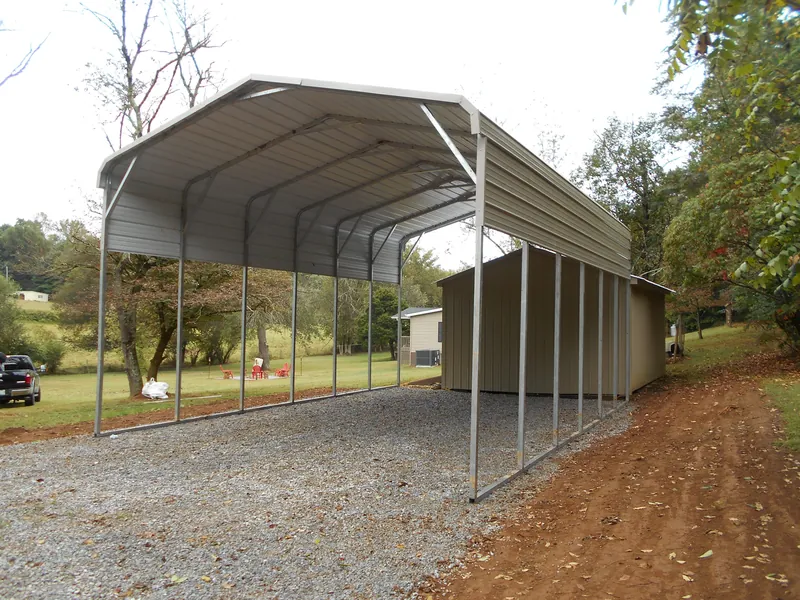
Leave Room for a Lean-To
A tall RV cover makes a good center building. These covers are made tall enough that a lean-to can be added to one or both sides later. A lean-to is a lower roof that attaches to the side of the main building, with its own row of posts on the outside, and it adds up to 14 feet of covered width. Under it go the things that do not need 14 feet of clearance: the truck that pulls the camper, the side-by-side, the lawn tractor, the firewood.
A lean-to is set at a lower pitch than the main roof, so the outer edge sits a couple of feet lower than where it meets the building. If you are planning a lean-to, buy enough side height on the center building that the lean-to still has useful clearance at its outside edge. Additions can only go onto an existing building from the same manufacturer, and changes stop once your order goes into fabrication, so we plan this with you before the order is placed. This is how a single RV cover can grow into a barn-style building over a few years.
A Vertical Roof for Longer Runs
RV covers get long fast. A 40-foot fifth wheel needs a building longer than 40 feet, and that is past the point where a horizontal-panel roof can be made in one piece. On regular and boxed eave roofs longer than 35 feet, the roof panels are spliced and overlapped, which creates seams that can leak. A vertical roof is the recommendation on anything over 35 feet, with panels running from the peak down to the eave so water drains straight off. For a short cover over a pontoon, a regular roof is a sensible way to save. For a long camper cover, plan on vertical. Our carport page compares all three roof styles side by side.
Level Ground and a Clear Path In
The install crew can set an RV cover on ground, gravel, concrete or asphalt, and covers installed on ground, concrete or asphalt are engineer certified. The crew will not level the site, so a sloped spot has to be graded before the install date. If the crew cannot level the building to the site, the materials go back and the install has to be rescheduled with a restocking fee, which is worth avoiding. Look up as well as down: no building goes up under overhead power lines, and a tall RV cover makes that easy to overlook. A tall or wide cover can also cross the line where a rented lift has to be on site during install; we check that when we price your design. The full site checklist is on our how it works page.
Why Order Your RV Cover Through Advance Solutions
- Measured for what you own. We talk through the camper, boat or trailer with you, including AC units, slide-outs and the tow vehicle, before you settle on a height.
- Planned for the next addition. We size the center building so a lean-to can go on later without starting over.
- A quote for your ZIP code. Send the form and we send you into the 3D designer to build the cover and see the price for your location.
- Delivery and install scheduled for you. Delivery and installation come with the price when your site is ready, and the goal is to have the cover up 3–6 weeks after your site photos are approved.
- Ways to pay over time. We can set you up with financing or rent-to-own if paying all at once does not work.